The Smartphone Effect: Is Your Phone Causing Your Neck Pain?
 By Dr. Aalap Shah
 02 Aug, 2026
  By Dr. Aalap Shah
02 Aug, 2026
By Dr. Aalap Shah
02 Aug, 2026
The Device In Your Hand May Be
Hurting Your Neck More Than You Realize
Take a moment and look around.
Someone is scrolling through social
media.
Someone is replying to messages.
Someone is watching videos.
Someone is working from their phone.
Now ask yourself:
How many hours do you spend looking
down at your phone every day?
For most people, the answer is far
more than they think.
What seems like a harmless habit has
quietly become one of the leading contributors to neck pain, stiffness,
headaches, and poor posture in today's world. Healthcare professionals now
refer to this growing problem as "The Smartphone Effect."
Your Neck Was Never Designed For
This
The human head weighs approximately
4–6 kilograms.
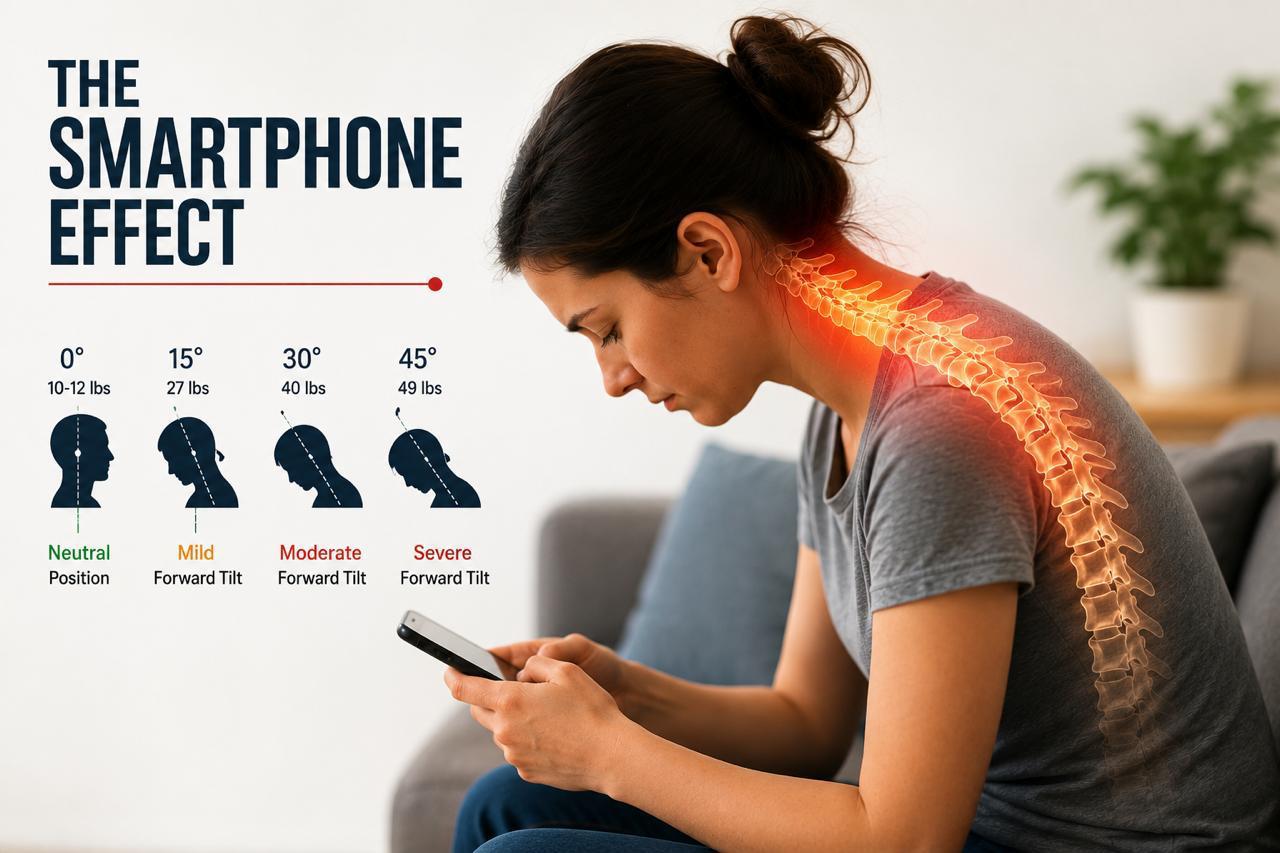
When your neck is in a neutral
position—ears aligned over your shoulders—the cervical spine comfortably
supports this weight.
The problem begins when you tilt
your head forward to look at your phone.
As the angle increases, the load on
the neck increases dramatically.
In a neutral position, the neck
experiences a load of approximately 25N.
When the head bends forward while
using a smartphone, that load can rise to nearly 60N.
To put that into perspective:
It's like placing the weight of a
6–7-year-old child on your neck for hours every day.
Now imagine doing that not once, but
every single day for years.
Why Cervical Pain Is Becoming So
Common
Twenty years ago, neck pain was more
commonly associated with ageing, physically demanding jobs, or injuries.
Today, teenagers, college students,
office workers, and young professionals are frequently reporting:
●
Neck
pain
●
Shoulder
tightness
●
Upper
back stiffness
●
Headaches
●
Reduced
neck mobility
●
Muscle
fatigue
The common factor?
Prolonged smartphone use and
sustained forward-head posture.
What Happens Inside Your Neck?
Your cervical spine consists of
seven vertebrae supported by muscles, ligaments, discs, and nerves.
When you repeatedly look down:
Muscles Become Overworked
The muscles at the back of your neck
work continuously to prevent your head from falling forward.
Over time, they become:
●
Tight
●
Fatigued
●
Painful
Joints Experience Excessive Stress
The small joints of the cervical
spine are exposed to greater mechanical loading, leading to irritation and
stiffness.
Discs Face Increased Pressure
Poor posture places additional
pressure on cervical discs, which may contribute to disc degeneration and nerve
irritation over time.
Nerves Can Become Sensitive
Persistent tension and compression
can increase nerve sensitivity, resulting in pain that may radiate into the
shoulders, arms, or upper back.
The Warning Signs Of "Tech
Neck"
Your body usually provides warning
signs before significant problems develop.
Common symptoms include:
●
Neck
stiffness upon waking
●
Pain
while looking down
●
Frequent
headaches
●
Tight
shoulders
●
Burning
sensation between the shoulder blades
●
Difficulty
turning the head fully
●
Tingling
or numbness in the arms
●
Feeling
the need to constantly stretch your neck
Many people treat these symptoms as
temporary discomfort.
However, they are often signs that
your neck is struggling to cope with the demands being placed upon it.
Why Young Adults Are Being Affected
One of the most concerning aspects
of the Smartphone Effect is the age at which symptoms are appearing.
Children and young adults now spend:
●
Hours
studying on devices
●
Hours
on social media
●
Hours
gaming
●
Hours
watching videos
As a result, we're seeing
posture-related neck problems at much younger ages than ever before.
Many people in their twenties are
already experiencing movement restrictions and chronic neck pain that were once
more common in older adults.
It's Not Just About Pain
The effects of poor smartphone
posture extend beyond the neck.
Forward-head posture can also
contribute to:
●
Shoulder
pain
●
Upper
back pain
●
Reduced
breathing efficiency
●
Muscle
imbalances
●
Increased
fatigue
●
Reduced
physical performance
Because the body works as an
interconnected system, a problem in the neck can eventually influence how the
entire body moves.
How To Protect Your Cervical Spine
The good news is that small changes
can make a significant difference.
Raise Your Phone- Bring your phone closer to eye level instead of lowering
your head toward the screen.
Take Movement Breaks- Avoid maintaining the same posture for long periods.
Try standing, stretching, or walking
every 30–45 minutes.
Strengthen Postural Muscles- Exercises targeting the deep neck muscles, upper back, and
shoulder stabilizers can improve posture and reduce strain.
Improve Workplace Ergonomics- Many people alternate between poor phone posture and poor
desk posture, multiplying the stress on their spine.
Stay Physically Active- Movement remains one of the most effective ways to maintain
spinal health.
The Bigger Question
The smartphone itself isn't the
problem.
The problem is the amount of time we
spend in positions our bodies were never designed to maintain.
Technology has made life easier in
many ways.
But it has also introduced new
physical challenges that our bodies are only beginning to experience.
Final Thoughts
Your phone may fit comfortably in
your hand, but the impact it has on your neck can be far greater than you
realize.
Every time you bend your head
forward, you increase the load on your cervical spine. Over days, months, and
years, that stress adds up.
So the next time you check a
message, scroll through social media, or watch a video, remember:
Your neck is carrying far more than
the weight of your phone.
And if you're already experiencing
neck pain, stiffness, headaches, or posture-related discomfort, your body may
be telling you it's time to look up.


 Dr. Richa Ojha
 Dr. Disha Shah
 Dr. Bansari Patel
 Dr. Janardan Mishra