The Contenders: What "Traditional" and "Technology" Really Mean
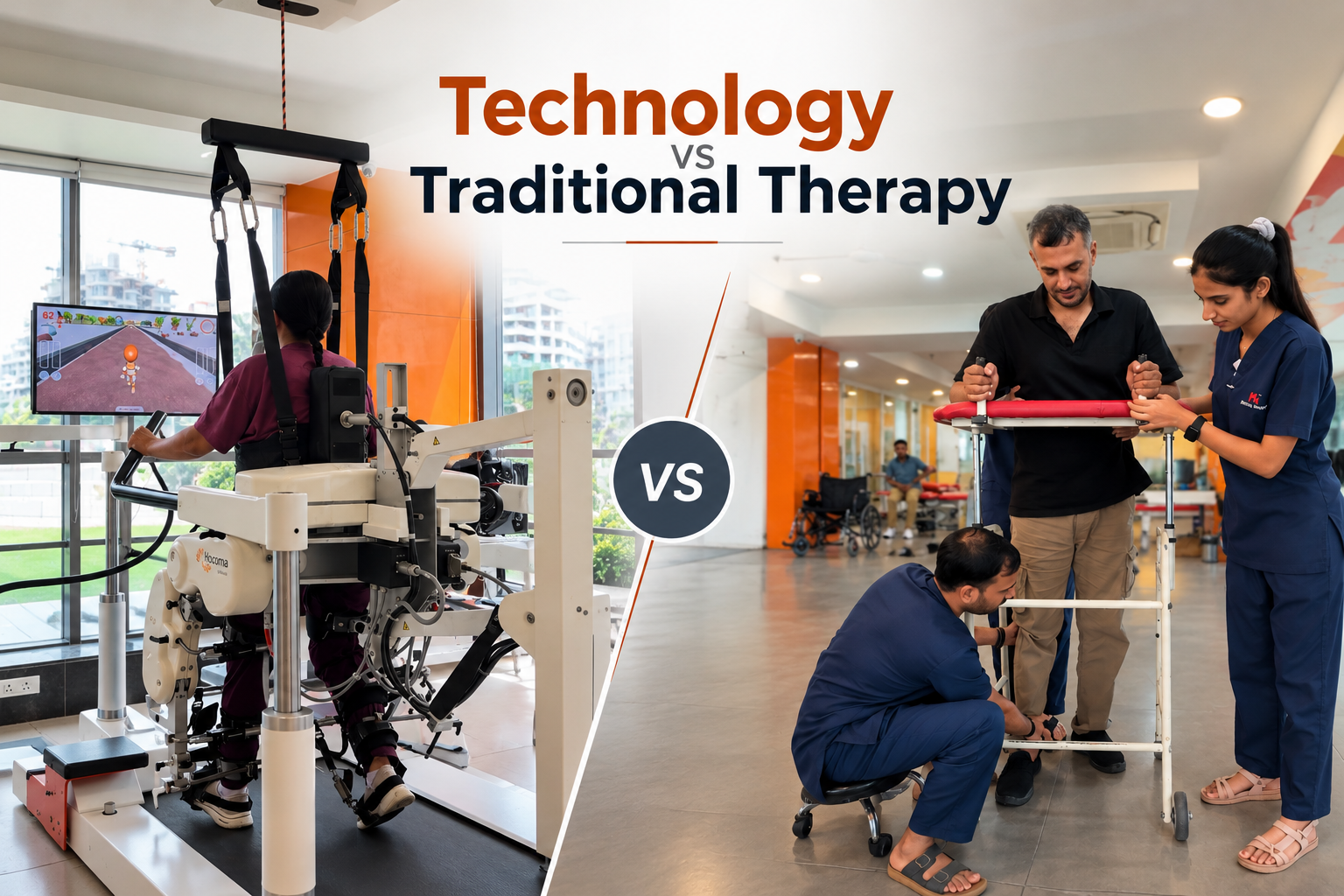
Traditional therapy is the work a physiotherapist does with their eyes, hands and judgement: a detailed assessment, manual techniques, a tailored exercise plan, coaching on how to move, and practice with real objects and real tasks.
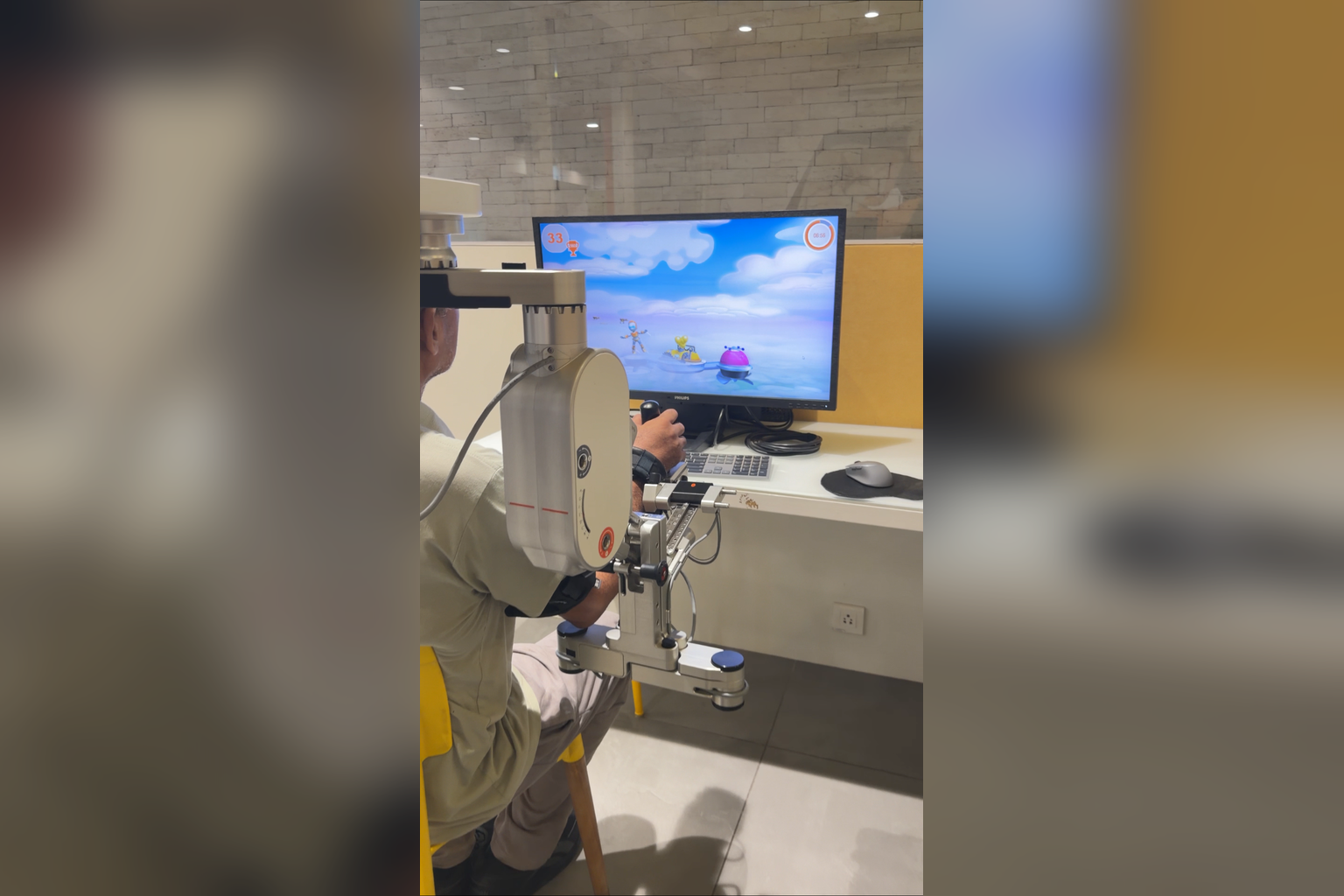
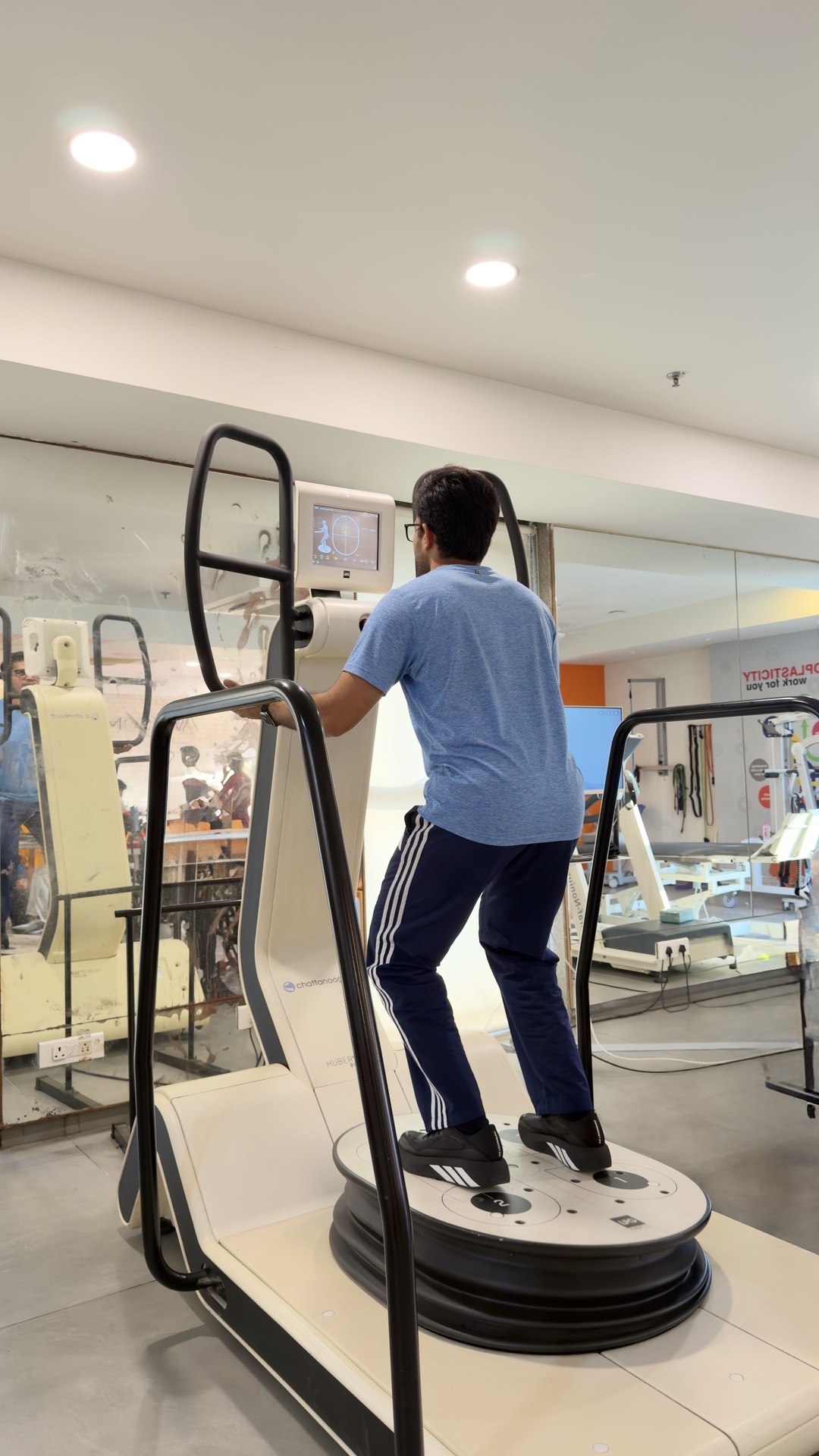
Technology-assisted rehab is a set of tools that carry out parts of that work with precision: robotic gait and arm trainers, treadmills with body-weight support, sensors that measure movement, feedback games, electrical stimulation and virtual reality.
Neither is a brand or a philosophy. Both are tools, and a tool is only as good as the person deciding when to use it.
Where the Machine Wins: Reps, Precision and Proof
- Repetition. Recovery after a neurological injury depends heavily on how much practice the brain and body get.
- Support. Body-weight and arm-weight support let someone who cannot yet stand or lift their arm begin practising safely, instead of waiting until they are strong enough.
- Precision and data. Sensors record the movement at every joint, so progress shows up in numbers, not only in impressions.
- Motivation. On-screen feedback turns an exhausting repetition into a task with a score, which keeps many patients going.
Where the Human Wins: Judgement, Touch and Trust
- Clinical reasoning. A dragging foot can come from weakness, stiffness, lost sensation, pain or fear. A machine repeats the movement. A therapist works out why it is happening, and that decides what helps.
- Reading the person. Fatigue, fear and frustration show on a patient's face before they appear on any screen. A therapist adjusts in the moment; software follows a setting.
- Hands-on care. Stiff muscles, painful joints and the shoulder that hurts after a stroke respond to skilled hands and careful handling.
- Carry-over to real life. Walking on a treadmill is not the same as climbing the stairs at home. Therapists practise the toilet, the kitchen, the kerb and the crowded market, the places where recovery actually has to work.
Who Gains Most From the Combination
No single rule fits everyone, but these patterns come up often.
Situation | Why the combination helps |
Cannot yet stand or walk (for example early after stroke or spinal cord injury) | Support lets practice begin sooner, while the therapist manages tone, transfers and safety |
Little or no active arm movement | Arm support allows guided practice, and the therapist prepares the muscles and joints around it |
Progress has slowed | Technology adds measurable, repeatable practice, and the therapist rechecks the goals |
The Mission Health Way: Technology Under a Therapist's Hand
At Mission Health, technology never replaces the therapist. It extends what the therapist can offer. A typical programme looks like this:
- Assess first. A physiotherapist examines strength, movement, tone, balance and daily function, and agrees goals with the patient.
- Match the tool to the goal. Robotic gait or arm training is chosen only when it fits the patient's stage and aim.
- Blend inside the session. Technology provides high-volume, guided practice, and the therapist works on the pain, stiffness and real-life tasks around it.
- Track what matters. Device data is read together with functional measures, such as walking speed and daily activities, and the plan is adjusted.
- Carry it home. A home programme keeps the practice going between sessions, and the technology is phased down as the patient moves toward independence.
The Verdict: It Was Never a Contest
Technology gives rehabilitation its dose: more practice, more precision, more proof. Therapists give it direction: the right goal, the right moment and the right adjustment. Take away either, and recovery loses something.
So do patients need both? For many, yes. For all, the real need is a team that knows which tool to reach for and when to put it down.
 By Dr. Richa Ojha
 22 Oct, 2026

 Dr. Disha Shah
 Dr. Aalap Shah
 Dr. Bansari Patel
 Dr. Janardan Mishra