Principles of Exercise: The Foundation of Safe and Effective Fitness
 By Dr. Janardan Mishra
 01 Sep, 2026
  By Dr. Janardan Mishra
01 Sep, 2026
By Dr. Janardan Mishra
01 Sep, 2026
Exercise is one of the most powerful tools for improving health, strength, mobility, fitness and quality of life. But simply exercising is not enough—how you exercise matters.
Whether your goal is weight loss, muscle building, improving stamina, recovering from an injury or staying healthy, understanding the basic principles of exercise helps you train effectively and reduce unnecessary injury risk.
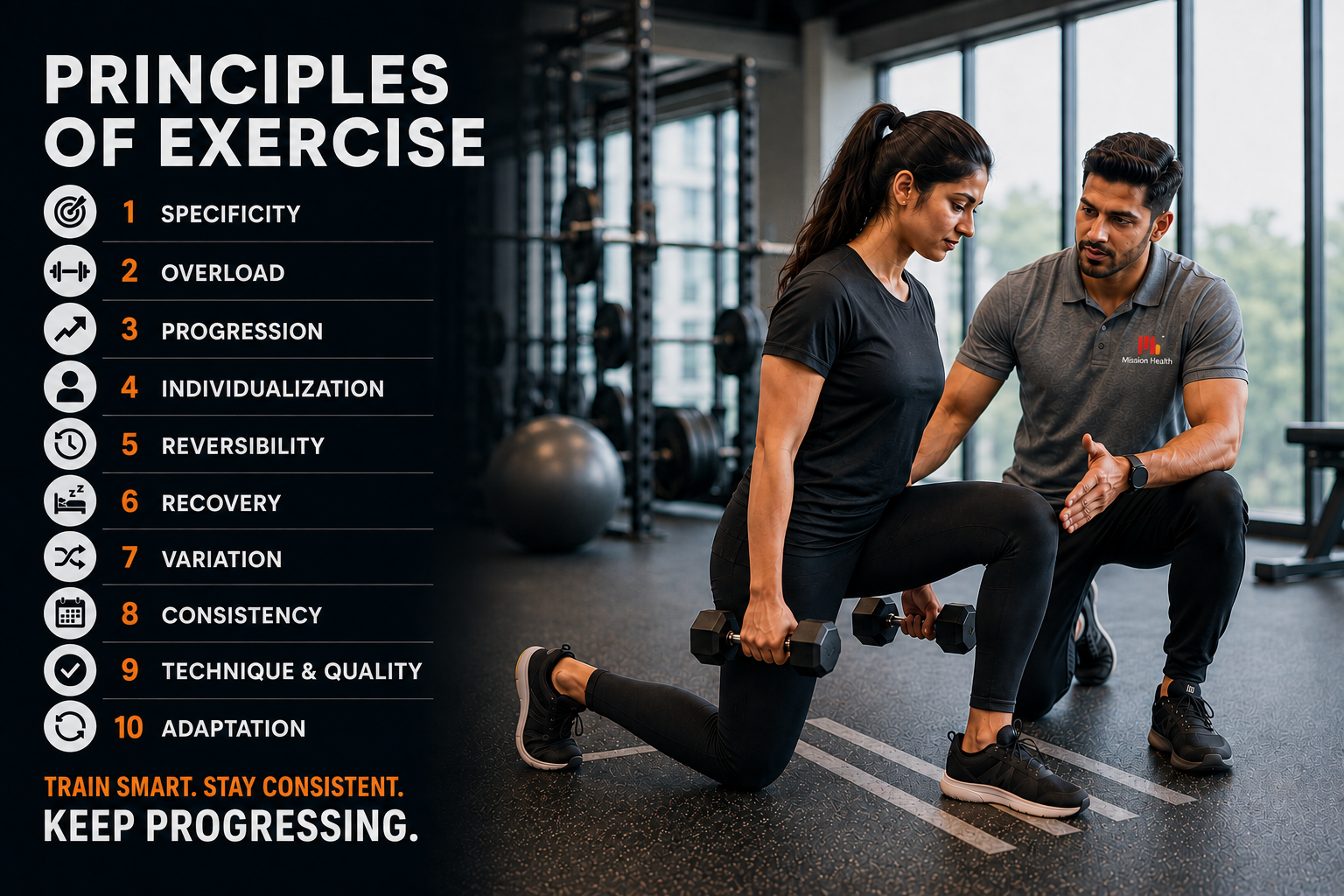
Your body adapts specifically to the type of exercise you perform.
Cardiovascular fitness requires cardiovascular training, strength requires resistance training, and better balance requires balance and coordination exercises.
The lesson: Train according to your goal.
The body needs an appropriate challenge to adapt. Overload can be created by gradually increasing:
Overload does not mean pushing yourself to exhaustion every day. The goal is to create enough stimulus while allowing recovery.
Overload should be introduced gradually.
Increasing training load too quickly can increase fatigue and injury risk. Progress should be challenging—but manageable.
There is no single exercise program that works perfectly for everyone.
Exercise should consider your:
The best exercise program is the one appropriate for the individual.
When regular training is stopped for an extended period, strength, endurance, mobility and other fitness adaptations can gradually decline.
This is often described as “use it or lose it.”
Long-term consistency is more valuable than short periods of extreme training.
Exercise provides the stimulus, but recovery allows adaptation to occur.
Recovery includes:
Training harder is not always better. A good program balances training and recovery.
Repeating exactly the same workout indefinitely is not always ideal. Appropriate variation can develop different physical qualities and maintain motivation.
A balanced program may include:
Strength training + cardiovascular exercise + mobility + balance + functional movements + recreational activities.
Variation should still have a purpose and fit within a structured plan.
One of the simplest—and most important—principles is:
Do it consistently.
A perfect workout once a month will not produce the same benefits as a sensible program performed regularly.
Choose a routine that is realistic, sustainable and maintainable over time.
Exercise is not simply about completing repetitions.
How you perform a movement matters.
Good technique can help improve movement efficiency, muscle targeting, control and performance while reducing unnecessary stress on joints and tissues.
Quality should generally come before simply adding more weight or repetitions.
The human body is remarkably adaptable.
With an appropriate training stimulus and adequate recovery, the body can improve strength, endurance, coordination and work capacity.
As your body adapts, an appropriate new challenge may be needed to continue progressing.
You don't need to be an athlete to apply these principles.
1. Identify your goal — strength, fitness, mobility, weight management or general health.
2. Choose appropriate exercises based on your goal and ability.
3. Start at an appropriate level rather than copying someone else's advanced program.
4. Progress gradually as your body adapts.
5. Recover properly with adequate sleep, nutrition, hydration and rest.
6. Monitor your response to training, including performance, fatigue, pain and recovery.
7. Stay consistent because meaningful results come from months and years of appropriate training.
If you have a significant injury, chronic medical condition, recent surgery, unexplained pain, or are unsure how to begin exercising safely, professional guidance can be valuable.
A qualified physiotherapist, exercise professional or medical professional can help determine appropriate exercises, intensity and progression for your individual needs.
Whether you are a beginner, regular gym-goer or athlete, understanding these principles can help you train smarter, safer and more effectively.
Remember: The best exercise program is not necessarily the most intense one. It is the one that is appropriate for you, progresses intelligently and can be sustained over time.


 Dr. Richa Ojha

 Dr. Disha Shah
 Dr. Aalap Shah

 Dr. Bansari Patel